
By Wonsuh Song
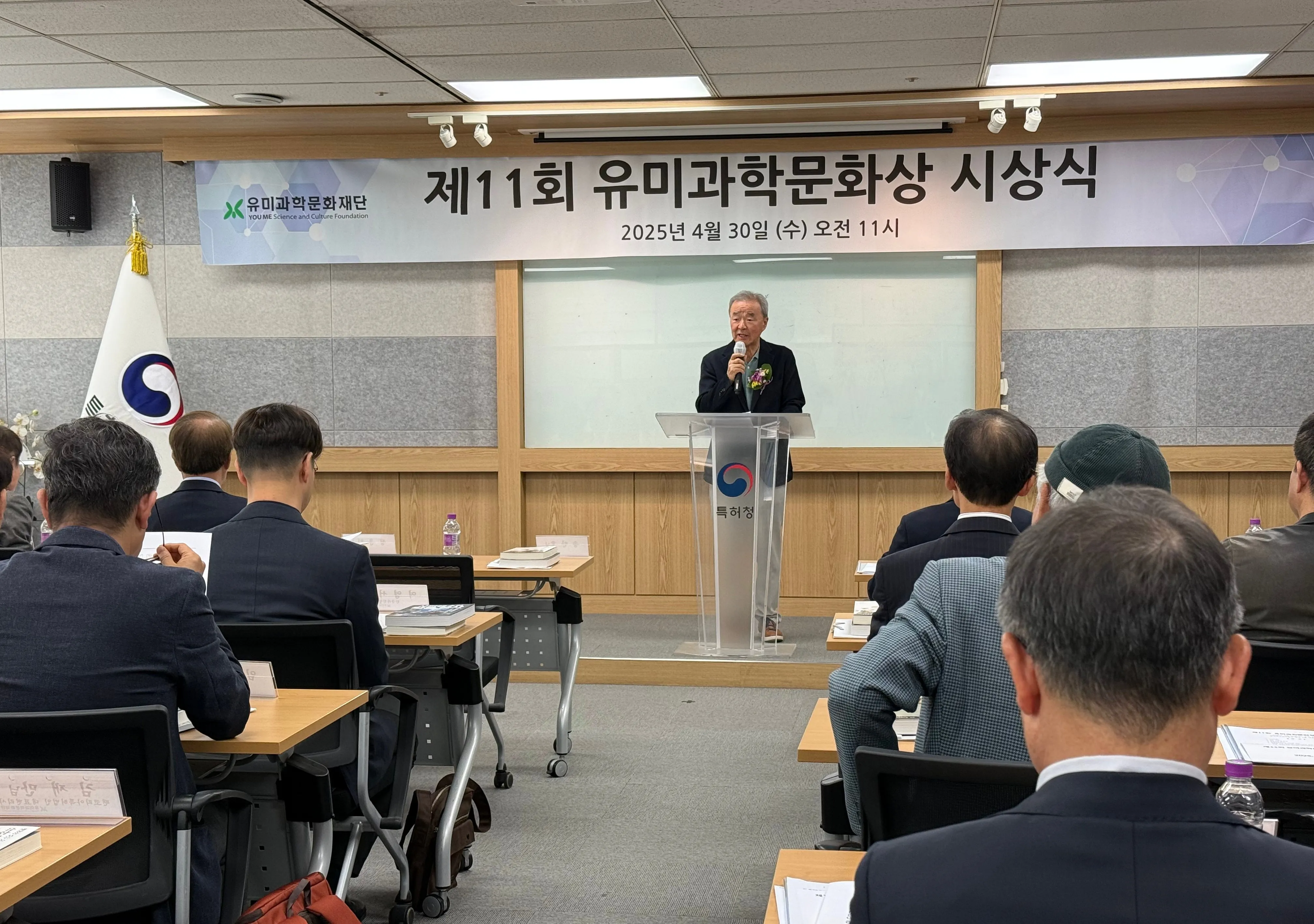
On 30 April, the 11th YOU ME Science & Culture Foundation (Chairman Man-Ho Song) award ceremony took place at the 5th-floor conference hall of the Korea Intellectual Property Center building in Gangnam, Seoul. The event drew significant attention from both the education and scientific communities, showcasing notable highlights such as the presentation of the Science & Culture Award to Professor Joong-won Lee of the University of Seoul—renowned for his work in the philosophy of science—as well as plans for Seoul National University’s new undergraduate college and the release of the new convergence-focused textbook, The Eye to the World: An Integrated History of Thoughts.
Professor Joong-Won Lee, honored with this year’s YOU ME Science & Culture Award, is a leading expert in the fields of the philosophy and history of science. He has produced outstanding research on various ethical and societal implications of cutting-edge technologies such as nanotechnology, artificial intelligence, and big data. In commending him for “breaking down disciplinary boundaries and making significant contributions to societal acceptance and value creation in science and technology,” the foundation presented him with a plaque and a 30 million KRW cash prize.
“I believe the philosophy of science is a vital foundation for new paradigms of knowledge that will guide future society,” Professor Lee said in his acceptance speech. “I remain committed to ensuring that science and technology serve the greater good of humanity.”

During a special session at the ceremony, Professor Yoo-Sun Noh, Dean of the newly established SNU College at Seoul National University (SNU), introduced the college’s vision and educational innovations. Launched last month, the new unit aims to realize “transdisciplinary convergence education” at the undergraduate level.
Dean Noh emphasized the introduction of “Veritas Class” an innovative teaching model in which teams of three professors lead interactive discussions with students. He noted that “these new classes are designed to cultivate creative thinking and convergent skill sets,” adding that while there are still challenges—such as a shortage of suitable convergence-based teaching materials and specialized professors—SNU plans to allocate funds to expedite the development of textbooks and courses to ensure this new educational model can flourish early on.

Chairman Man-Ho Song of the YOU ME Science & Culture Foundation announced the release of a new convergence-focused textbook entitled An Integrated History of Thoughts (co-authored by Man-Ho Song, Jung-Ho Ahn, Gi-Bin Hong, and Eunsoo Lee; published by Bada Books) in April. He described it as a comprehensive look at 5,000 years of human intellectual history—examining philosophy, religion, history, politics, and economics through the lens of science—asserting that “it will be extremely helpful for anyone aiming to implement truly transdisciplinary education.”
Professor Eunsoo Lee of SNU’s Department of Philosophy explained that “from the second semester, we plan to use An Integrated History of Thoughts in our ‘Expanding Knowledge’ course at the new undergraduate college,” and that the textbook reinterprets Western philosophy, religion, history, and politics/economics from a modern scientific standpoint.
Meanwhile, the foundation is also seeking to register An Integrated History of Thoughts as an official ‘recognized’ high school textbook, following the path of its predecessor The Deep History of Sapiens (co-authored by Man-Ho Song and Jung-Ho Ahn), which has been adopted as part of the regular high school curriculum in six high schools across the nation (including Seoul’s Hana High School) and introduced in various college courses.
Also featured at the ceremony was the selection of Lisa Feldman Barrett’s Seven and a Half Lessons About the Brain(Korean edition: 이토록 뜻밖의 뇌과학) as the Outstanding Science Book of the Year. It will be distributed free of charge to 1,000 high schools across the country. According to the judging panel, the book “explores the essence of humanity and our social connectedness through an interdisciplinary approach centered on neuroscience, promotes scientific literacy and integrative thinking, and emphasizes ethical insight and social responsibility.”
In the category for “Excellence in Reading Guidance,” recognized by the Ministry of Science and ICT, the winners were teachers who showed outstanding performance in guiding student reading activities: Mr. Hyeong-Sik Jung from Hana High School received the Minister’s Award, while Ms. Soo-Jin Heo from Gyeongbuk Yeongdong High School and Mr. Hyeon-Sik Shin from Chungnam Buyeo Girls’ Middle School were honored with the Commissioner’s Award from the Korean Intellectual Property Office.
In the opening remarks at the start of the ceremony, Chairman Man-Ho Song reflected on the “10 years spent emphasizing the importance of convergence education,” expressing concern that “lack of funding and infrastructure prevented it from fully taking root.” He praised Seoul National University for “boldly investing in the realization of transdisciplinary convergence education despite limited financial resources.”
Adding that SNU “should strive to share its newly developed textbooks and course materials with other universities and high schools around the country,” Chairman Song also underscored the need for various convergence-oriented textbooks and trained instructors—especially now that Korea is officially rolling out the high school credit system. “We’re hoping that An Integrated History of Thoughts will soon be registered as a recognized textbook,” he continued, stressing that “collaborations between universities and secondary schools can significantly accelerate the pace of educational innovation.”

Following the opening ceremony, notable figures including former Prime Minister Un-chan Chung, Seoul Metropolitan Office of Education Superintendent Hee-Yeon Cho, former Korea Foundation for Science & Creativity President Yul-Rae Cho, Chief Judge of Korean Intellectual Property Office Eul-Soo Seo, and SNU College Dean Yoo-Sun Noh delivered congratulatory remarks and took part in the awards presentation. After remarks from the awardees, Mr. Hyeong-Sik Jung of Hana High School discussed his experience teaching with The Deep History of Sapiens, and Hyun-Woo Kim, a freshman in SNU’s Department of Philosophy, shared how studying the material influenced his academic perspective.
A closing address and commemorative photo session brought the official proceedings to an end. Described by participants as a convergence of “science culture and cross-disciplinary education,” the event successfully highlighted mutual collaboration possibilities between the educational and scientific communities.

According to a representative from the YOU ME Science & Culture Foundation, “All details from the event will be available on the Foundation’s website (www.youmeacademy.org). We plan to continue supporting and promoting convergence between science and the humanities going forward.”
With Korea’s focus on educational reform and broader innovations, the impact that “transdisciplinary convergence education” will have on the nation’s future remains of great interest.
Wonsuh Song









댓글 남기기