By Wonsuh Song
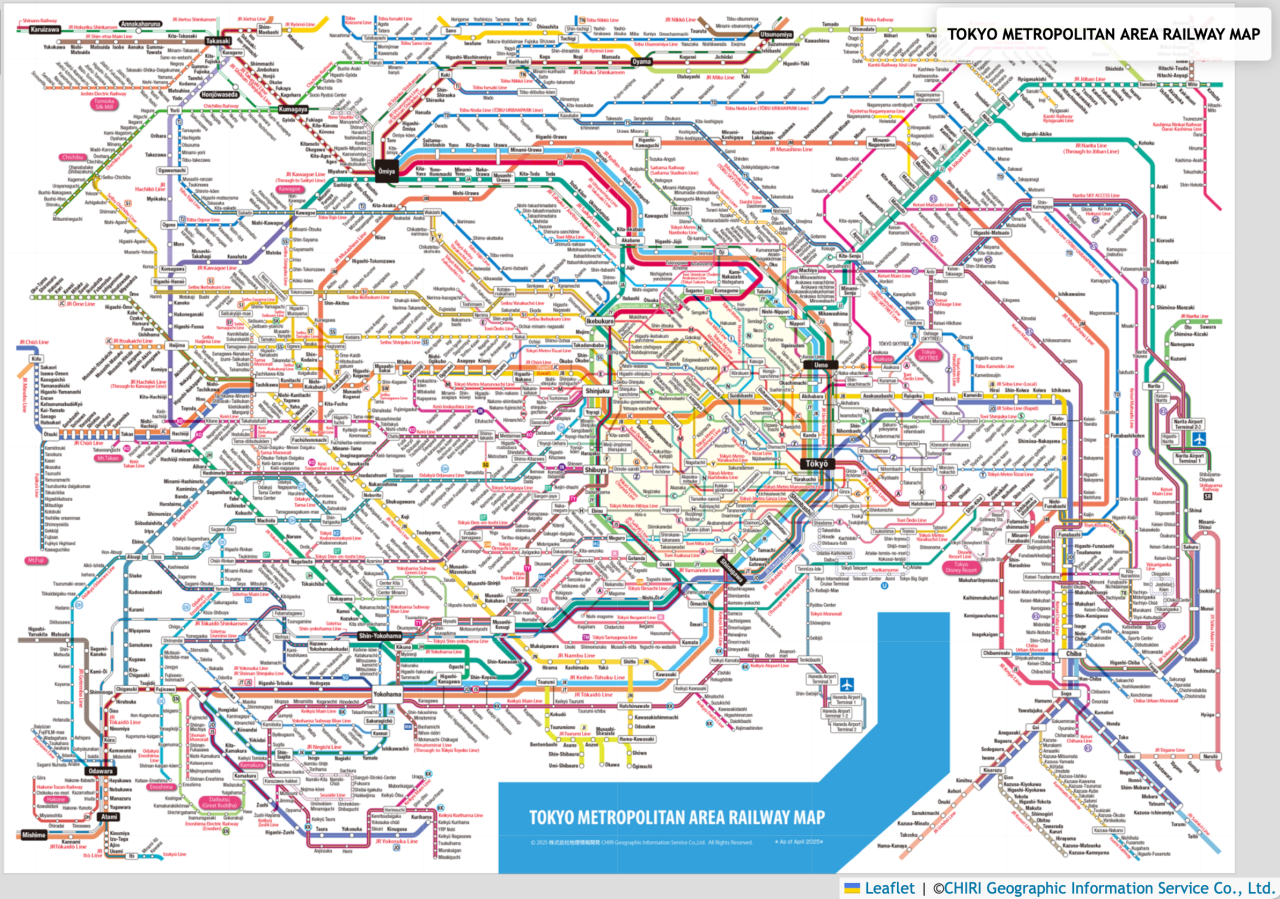
Tokyo’s extensive rail network is often hailed as one of the world’s best, and such praise is hardly an exaggeration. With over 150 different train lines and more than 1,700 stations dotted across the greater metropolitan area, the system’s map can be so densely packed that you have to enlarge it just to read the station names. This sprawling network seamlessly connects the city center to its sprawling suburbs, accommodating the daily commute of countless individuals. Thanks to trains running at intervals of just a few minutes, it’s entirely possible to travel long distances without a car, and it’s not unusual to see a train door close precisely at the moment announced—say, exactly 8:02 a.m. If any delay arises, stations promptly broadcast apologies for the inconvenience, underscoring the unwavering commitment of Japan’s railways to operate on schedule.
But behind this famed efficiency lies a system of daunting complexity. Tokyo Metro, JR lines, and various private railways are interwoven, sometimes to the point that even long-term residents find themselves confused about certain routes. On the very same platform, you might find trains heading toward central Tokyo at one moment, then away from it the next—and even trains traveling in the same direction can split off mid-journey to entirely different destinations. I myself have lost count of how many times I boarded the wrong train while commuting from Tokyo to Chiba Prefecture. Despite having lived in Japan for over 23 years, I still occasionally realize, far too late, that I’m on the opposite-bound train. Even buying Shinkansen tickets can turn into a small adventure, making me wonder if I have some spatial navigation problem.
Yet, in a network this vast, getting momentarily lost seems almost inevitable. Such mistakes are by no means rare, so there’s little reason to beat yourself up over lost time due to a wrong train. In fact, given the system’s complexity, it’s almost a rite of passage to experience at least one mix-up. Another facet of Tokyo’s railways is the frequency of accidents and emergencies, partly due to the sheer volume of riders. Near major transport hubs like Shinjuku Station, ambulances standing by is a familiar sight, and witnessing someone faint on a crowded platform is no longer surprising.
Despite—or perhaps because of—this elaborate setup, Tokyo’s train network manages to connect the metropolis with remarkable thoroughness, powering daily life with uncanny efficiency. Even a geography expert can accidentally hop on the wrong train, and a long-time resident can, on any given day, end up on a completely unexpected route. On a warm spring morning, being briefly disoriented in a packed train is no reason for despair; after all, the train heading back to your intended destination usually isn’t far behind. In a space that’s simultaneously complex and efficient—teeming with a diverse array of people—getting lost at least once can be a surprisingly insightful way to gain a clearer understanding of this vast city.
Song Wonsuh (Ph.D.)
Full-time Lecturer, Shumei University / NKNGO Forum Representative










댓글 남기기