
By Wonsuh Song
These days, when you open a smartphone messaging app, you’ll often see various “reaction emojis” for each message. Popular platforms such as KakaoTalk in South Korea, LINE in Japan, and Facebook Messenger worldwide all feature convenient one-click buttons that go beyond simple text, allowing users to quickly express their emotions. It’s quite intriguing how these tiny emoji buttons can subtly shape our daily interactions and relationships.
For example, KakaoTalk offers six basic reactions: “Like” (thumbs up), “Love,” “Check,” “Surprised Face,” “Smiling Face,” and “Crying Face”. With these simple icons, users can convey their feelings about a received message without having to add extra text. In some cases, emojis can make an even stronger impression than words alone.
Likewise, Japan’s primary messenger app, LINE, includes six reaction emojis—such as hearts, smiles, shocked faces, and crying faces. Much like KakaoTalk, LINE’s straightforward and intuitive design suits Japanese communication styles, making it widely popular.
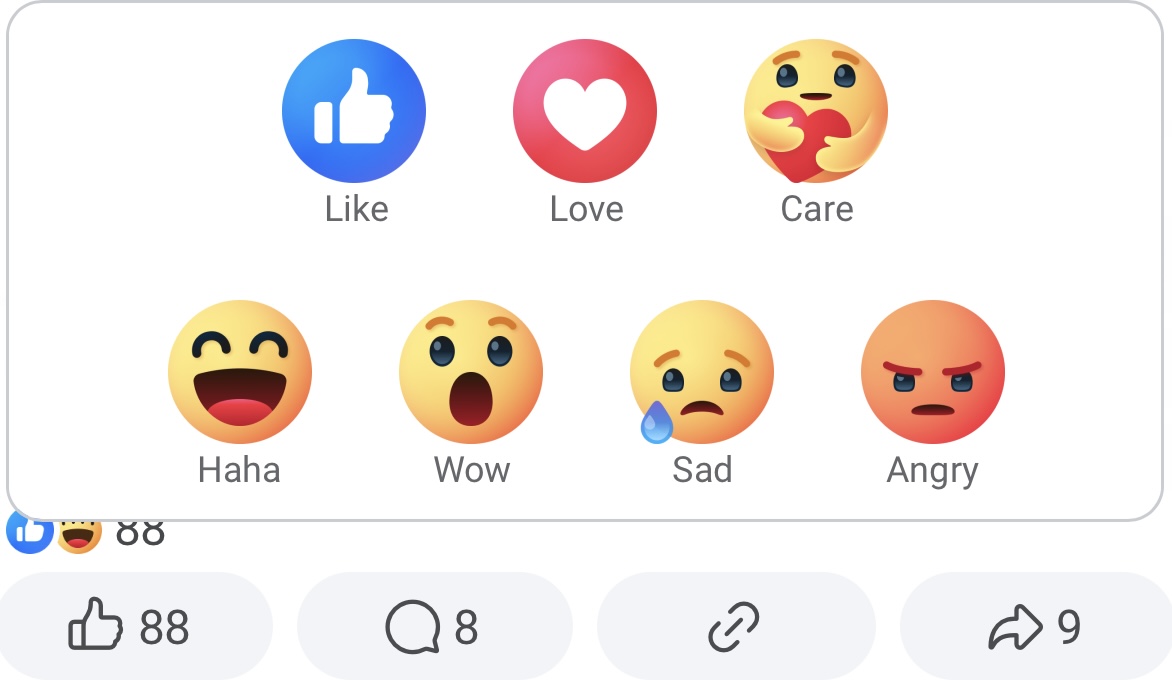
Facebook Messenger’s reaction buttons provide yet another fascinating example. Although it’s a global platform, the same emojis may be interpreted differently depending on the country or region. Typical reactions include the heart, laughing face, surprised face, crying face, angry face, and a thumbs-up “Like.” In Japan, however, the emoji labeled “Love” might not be translated directly as “Love,” but rather rendered as “Super Like (超いいね).” This approach reflects a cultural tendency to soften the directness of words like “love.”
Among all these reactions, the heart emoji is often the trickiest to use. Whether in South Korea, Japan, or elsewhere in Asia, there’s some hesitation in sending a heart to a boss, a subordinate, or a colleague you don’t know well. It can feel a bit embarrassing, or it may reduce the interpersonal distance in a way that’s uncomfortable. Still, when it comes to discreetly conveying warmth or affection you might struggle to articulate face to face, there’s nothing more convenient than that single tap of a heart icon. It’s precisely this gentle but potent quality that makes the heart emoji so intriguing.
In many Asian social media and messaging apps, the heart doesn’t necessarily convey direct “love.” Rather, it often suggests something along the lines of “that’s really good,” “I really like this,” or “that’s awesome.” This is somewhat different from the more explicit way such emojis might be used in the West. By expressing affection in a more ambiguous way, users can maintain the relationship without being overly forward—an approach that might be described as an “Eastern” style of communication.
Looking at it this way, even the smallest reaction emoji can reveal diverse modes of emotional expression across different regions and cultures. In this digital era, where we can express our feelings with a single click, our style of communication continues to evolve. Sometimes we rely on a “tingly” heart reaction to convey a sentiment that words alone can’t fully capture. And that one little click can foster a sense of closeness—or, occasionally, spark unexpected misunderstandings.
Even though anyone can use these reaction buttons with ease, their interpretation can vary widely depending on cultural and linguistic context. This subtle yet careful form of communication—born from something as simple as reaction emojis—may well be a new “face” of modern digital society. In the future, we’ll likely keep packing our feelings into that tiny heart, navigating the fine line between connection and overstep, and exploring new ways to interact along the way.
Wonsuh Song (Ph.D.)
Lecturer at Shumei University / NKNGO Forum Representative
https://geographersong.jp/about/










댓글 남기기