
by Wonsuh Song
I came to Japan after graduating from university, which meant I had never directly experienced the country’s daycare, kindergarten, or its elementary, junior high, and high schools. It was only through raising my children here—watching them go through these educational institutions—that I indirectly learned about Japan’s education system. Along the way, I found myself gaining a deeper understanding of Japanese society and culture.
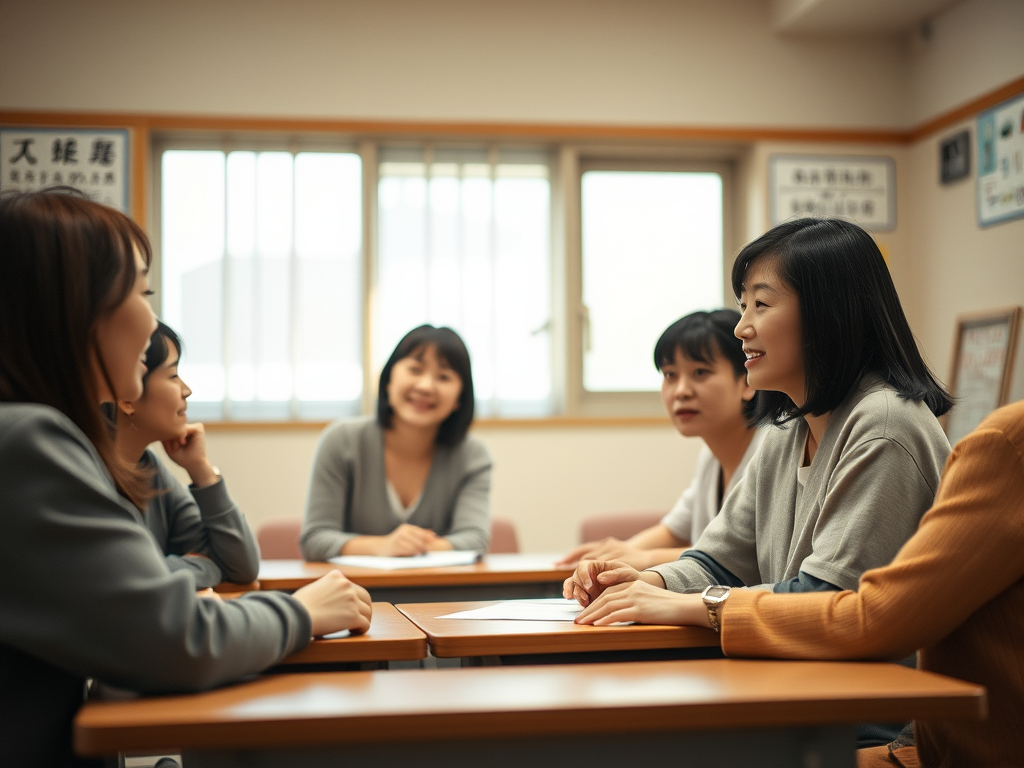
After having lived in the same town for 17 years, I moved to Tokyo. My eldest child had to transfer to a new elementary school where I knew no one, so I looked for ways to connect with other parents. I ended up joining the PTA choir. I had never sung in a group before, let alone performed, but sharing songs and harmonies with people I had just met turned out to be a refreshing and meaningful experience.
This PTA choir participates in a choral competition every year. The first piece I practiced was called “Gunjō” (meaning “Ultramarine”), which I learned had been composed by a teacher and written by a group of graduating students at an junior high school that suffered significant damage during the 3.11 Great East Japan Earthquake. I struggled to read the sheet music, and since I couldn’t figure out the timing of when the song reverted back to an earlier part, I found myself fumbling around. Above all, the song’s lyrics struck a chord in me; they were so heartrending that I struggled to hold back tears in rehearsal.
When I thought back to the time of the earthquake, memories came flooding in: the confusion of caring for a very young child, anxiety about the safety of food due to the nuclear accident, and the ongoing barrage of unsettling news. Every time I sang that song in rehearsal, it resurrected the raw emotions of that period. More than once, tears welled up unexpectedly.
Now, fourteen years have passed since 3.11. Every year on March 11th, the atmosphere across Japan turns solemn in remembrance. I, too, recall how heightened the fear of radiation was, how so many people were forced to live in difficult conditions, and how—despite these tragedies—time inevitably leads to fading public awareness. At the same time, I realize that the 1995 Great Hanshin-Awaji Earthquake is also still commemorated annually, revealing a culture that honors and preserves lessons learned from repeated natural disasters.
This year, my second child graduated from elementary school, bringing my PTA choir activities to a close. Still, what I gained from that experience—learning how to bring voices together—showed me a valuable aspect of Japanese society, where people support one another whether it is in the face of life’s small challenges or monumental disasters. I believe that frequent natural disasters have imbued a sense of caution and collective mindset in people’s lifestyles and attitudes here.
Time does indeed fly. Yet the scars of the earthquake and the pain in people’s hearts have not completely healed. The lingering thought of “When might the next big quake strike?” can never be entirely erased. Nevertheless, all we can do is stay prepared, keep an eye out for one another, and live our lives as best we can.
Marking the fourteenth anniversary of 3.11, I am reminded of that day and the weight of natural disasters that may still lie ahead. Our everyday lives rest on a precarious foundation that can crumble at any moment—this is something we must not forget. Yet in the midst of this uncertainty, the effort to “sing in harmony,” so to speak, by listening to each other and uniting, is what strengthens our resolve to move forward.
Honoring and remembering the past is the cornerstone of building a better future.
Just like the resonance of a chorus, gathering and blending our diverse voices can help us move toward a brighter tomorrow.
Gunjō (Ultramarine)
Ah, born in that town, I met you there
Embracing countless feelings, we spent our days together
Now the day has come to depart—though what we see may differ
From some distant place, you must be looking up
At the same sky as I am
I wave goodbye, saying, “See you again,”
But will we truly meet tomorrow?
I still can’t forget your smile
Growing faint in the distance
That sunset we saw that day, those fireworks we saw that day
You were always there
I realized that the ordinary itself was happiness
Riding our bicycles, we went to the sea
Those vivid memories
Turn to ultramarine when I close my eyes
Two years have passed since that time
Buffeted by the March winds, I still think of you
Let this singing voice resound
Resound far into the distance, beyond that sky
Reach everything we hold dear
Even in the aftermath of tears, in the night sky we gaze upon
Hope is shining there
In the ultramarine town that awaits us
Ah—
Surely, we will meet again
Let’s meet in that town—our promise
Will not vanish, our ultramarine bond
Let’s meet again
In the ultramarine town
Lyrics by the 2012 Graduating Class of Odaka Junior High School, Minamisōma City, Fukushima Prefecture
Music by Miki Oda, Teacher at Odaka Junior High School, Minamisōma City, Fukushima Prefecture
Wonsuh Song (Ph.D.)
Lecturer at Shumei University / NKNGO Forum Representative







댓글 남기기